

Understanding two prestigious academic pathways and how to choose the best route to university success
Choosing the right educational pathway is one of the most important decisions families make during their child's secondary education. In Switzerland, two highly respected qualifications offer excellent preparation for university: the Swiss Maturité and the International Baccalaureate Diploma Programme (IB DP).
Both are academically rigorous, internationally respected and designed to develop knowledgeable, independent learners. However, they differ in their structure, teaching approaches, assessment methods and university pathways.
At Saint-Charles International School in Porrentruy, Switzerland, students can benefit from both educational traditions. Understanding their differences is the first step towards choosing the pathway that best suits each student's strengths, interests and ambitions.
What is the Swiss Maturité?
The Swiss Maturité is Switzerland's traditional academic qualification, providing a broad and intellectually demanding education. It is particularly well suited to students considering university studies in Switzerland, although it is also recognised internationally.
Students follow a comprehensive curriculum that includes languages, mathematics, sciences, humanities and other subjects. This breadth ensures that graduates develop a strong foundation across multiple academic disciplines.
One of the principal advantages of the Swiss Maturité is its relationship with Swiss higher education. A recognised Swiss gymnasial Maturité generally provides direct access to Swiss universities, subject to specific requirements for certain programmes and institutions.
At Saint-Charles, the Swiss pathway follows the four-year Lycée structure, combining academic expectations with a bilingual learning environment.
For students who value a broad education, enjoy studying multiple subjects and are considering Swiss universities, the Maturité can be an excellent choice.
What is the International Baccalaureate Diploma Programme?
The International Baccalaureate Diploma Programme is a two-year qualification for students aged approximately 16–19, recognised by universities around the world.
Students study six subjects across different disciplines, normally combining three at Higher Level and three at Standard Level.
The programme also includes three distinctive core components: Theory of Knowledge (TOK), the Extended Essay (EE) and Creativity, Activity, Service (CAS).
These encourage students to explore how knowledge is constructed, undertake independent research and participate in meaningful activities beyond academic study.
The IB is particularly attractive to internationally mobile families and students considering universities in the United Kingdom, Europe, North America and other destinations.
At Saint-Charles, the IB Diploma Programme combines academic ambition with individual guidance and an international outlook.
The school's recent results reflect this commitment, with a 100% Diploma pass rate across recent graduating cohorts, an average score of 33.8 points and 17% of students achieving 40 points or more.
Swiss Maturité vs IB Diploma: Key differences
Although both qualifications provide excellent academic preparation, several distinctions may influence a family's decision.
| Swiss Maturité | IB Diploma |
|---|---|
| Broad curriculum across numerous subjects | Six subjects with selected areas of greater depth |
| Typically four years at Lycée level | Two-year Diploma Programme |
| Strongest direct university access in Switzerland | Widely recognised for international university applications |
| Emphasis on sustained academic breadth | Strong emphasis on research, critical thinking and independent inquiry |
| Particularly suited to students planning Swiss higher education | Particularly suited to internationally mobile students |
Neither qualification is inherently superior. Their suitability depends on the individual student and intended university destination.
Importantly, the IB Diploma does not automatically provide unrestricted access to every Swiss university. Swiss universities may require particular subject combinations, levels and grades. Similarly, international universities may impose specific conditions for Swiss Maturité applicants.
Families should therefore consider future university requirements before making a final decision.
Which pathway is best for university admission?
For students intending to study at Swiss universities such as the Universities of Geneva, Lausanne, Zurich or Basel, the Swiss Maturité offers a particularly straightforward route.
For students considering universities internationally, the IB Diploma offers a familiar qualification that admissions teams can evaluate consistently across different educational systems.
However, both qualifications can support applications to prestigious universities worldwide.
The most important considerations are the student's academic strengths, preferred subjects, language proficiency and long-term ambitions.
At Saint-Charles, individual academic guidance helps families understand these considerations and make informed choices.
What if a student needs a different pathway?
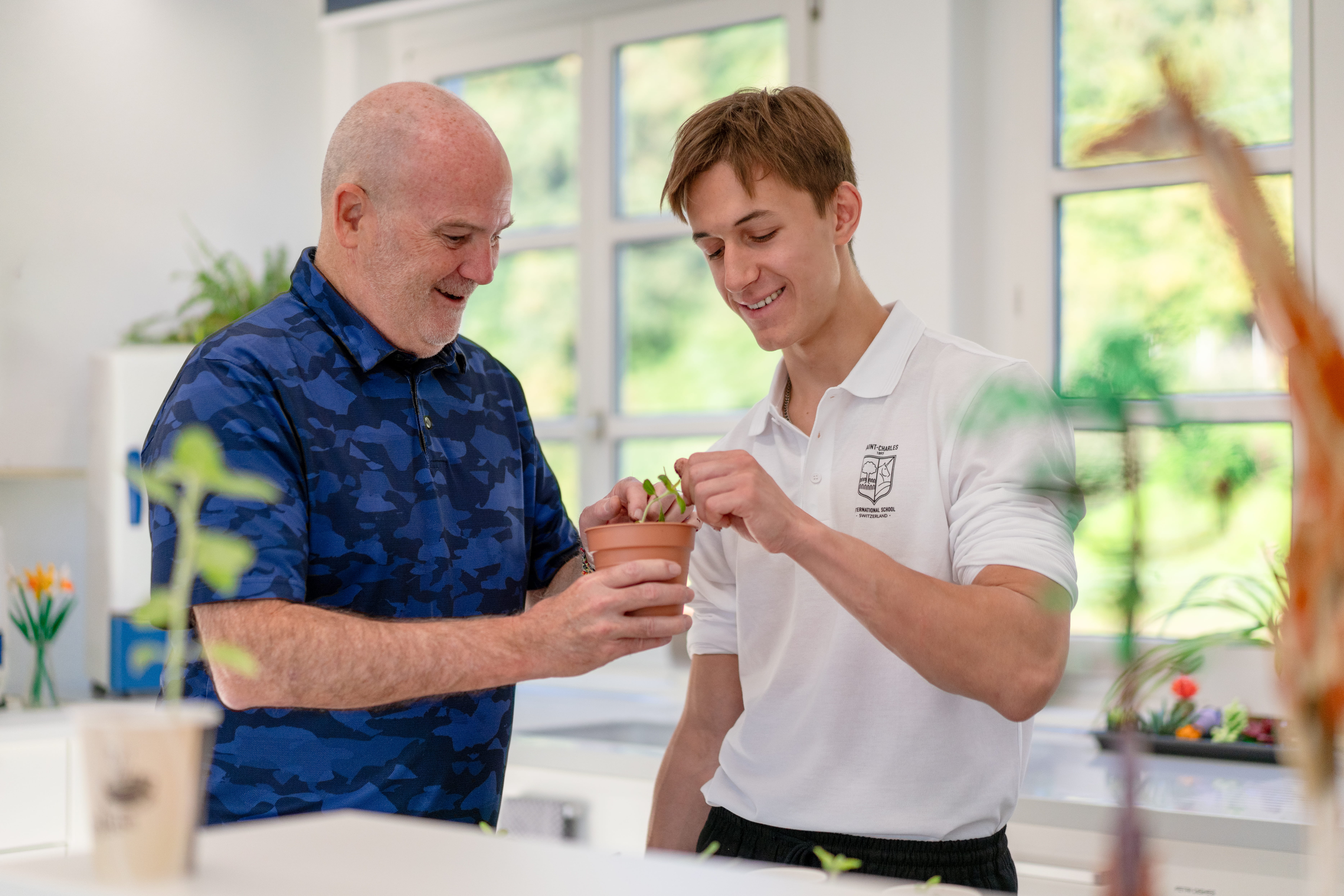
Not every student develops academically at the same pace, and not every young person has identical aspirations.
This is why educational flexibility matters.
Alongside the Swiss Maturité and IB Diploma, Saint-Charles offers a High School Diploma pathway, combining selected IB subjects with professional skills, life skills and broader personal development.
Preparatory programmes also help students build the academic knowledge, language proficiency and learning habits required for subsequent study.
This range of opportunities reflects a central Saint-Charles conviction: successful education begins with understanding the individual.
OUITSTANDING EDUCATION